When Is Gambling Not Gambling? Canada's stance on Fantasy Sports and Prediction Markets
Drafting fantasy sports lineups, taking part in free-to-play tournaments, and trading prediction contracts have become a normal part of Canadian life. Sports betting, iGaming and the culture around them have evolved significantly, and regulators in Canada are struggling to adapt to this new world.
CasinoCanada.com's research finds a regulatory framework built around casinos and licensed sportsbooks now facing a much wider, younger, and more casual gaming culture that doesn't map neatly onto it.
Research Highlights
Ontario's fantasy sports base tops two million players (FSGA).
- Global social casino market: $10.08bn in 2026, heading to $14.42bn by 2030 (Research and Markets).
- US prediction markets hit ~$24bn a month by April 2026 – nearly double the monthly US sportsbook handle (Pew Research Centre).
- 1 in 3 young Canadian adults (18-29) gambled online in the past year (Greo / CCSA, Nov 2025).
- Men 18-34 are prediction markets' biggest users, betting at more than double the general rate (SSRS Sports Poll, May 2026).
- 62% of online gamblers started on social casino games before real-money gambling (Kim et al., 2017).
- Almost 1 in 8 Ontario high schoolers have played social casino games (CAMH, 2018).
- 58% of Canadians oppose legalising prediction markets (The Logic, July 2026).
- 61% of Americans see prediction markets as gambling, not investing – just 8% disagree (Ipsos/AIBM, Feb 2026).
- 26% of Gen Z already treat sports betting as part of their investment strategy (Betterment, 2026).
A Cultural Shift
Canada is experiencing a cultural shift in attitudes towards gambling. Ontario's legal market opening its doors to external operators in 2022, and Alberta following suit this summer, have resulted in increased public interest in gambling and have also opened up discussions on what constitutes gambling and how this impacts society.
At the same time, Gen Z has emerged as a commercial force and is adopting new technologies, games, and formats that involve staking and/or rewards. This combination is putting increasing pressure on regulators.
A 2026 Betterment survey found 26% of Gen Z respondents already classify sports betting as part of their long-term investment strategy, and 60% say they get financial advice from social media.
The delivery layer has changed just as much as the products themselves. Where older generations experienced gambling as a solitary, transactional activity, Gen Z and younger millennials engage around social features, live chat, streamers and community validation.
Loyalty mechanics borrowed from mobile gaming such as leaderboards and achievements now show up across casual and real-money products alike, while a 2024 GoDaddy survey showed that 41% of Gen Z trust an influencer over a business ad, making TikTok and streaming platforms essential in reaching younger players.
These changes are not likely to slow down. Expect more hybrid skill-and-chance formats, deeper gamification, and continued crossover with mainstream fintech apps. One such case is Wealthsimple, a Canadian investment management service, rolling out a prediction platform in Canada. These aren't a threat to the regulated industry, but an indication that conversations need to happen about what defines gambling.
No Legal Definition
Canada's entire gambling framework runs through one test, and it's stricter than most people assume. An activity is considered illegal gambling under Section 206 of the Criminal Code if three elements are present: a prize, chance, and consideration (an entry fee or payment to play).
Remove any one of those three, and the activity falls outside the section entirely. The part that trips up most new products is chance. Canadian courts, including the Supreme Court, have explicitly rejected the "predominance" approach used in some other jurisdictions, where skill can outweigh chance.
In Canada, any element of chance at all, however minor, is enough to make an activity a "game of mixed chance and skill," which is treated the same as pure gambling under Section 206. Only a genuinely chance-free activity qualifies as a game of pure skill, and pure-skill activities fall outside the Criminal Code's gambling provisions altogether.
Ongoing Debates
Daily fantasy sports (DFS) has been arguing its case for more than a decade. In 2015, the Canadian Gaming Association commissioned a legal opinion from Don Bourgeois, former AGCO general counsel, concluding that DFS is not a pure game of skill under the Criminal Code and should be treated as gambling. However, this has never been tested in court.
Ontario has since split the difference: the AGCO's own iGaming standards classify fantasy sports products as a form of sports betting, meaning any DFS operator serving Ontario players needs to register as a licensed iGaming operator. Everywhere else in Canada, DFS occupies the same space it did in 2015, operating with legal uncertainty.
Free-to-play "social casino" games avoid the question entirely. Slot, poker, and table-game apps that let players wager virtual credits instead of real money don't meet the legal definition of gambling because nothing of monetary value changes hands.
This is one of the fastest-growing industries in North America, with Research And Markets estimating the global social casino industry is worth an estimated $10.08 billion in 2026, on track for $14.42 billion by 2030, with North America its biggest region.
The Rise of Prediction Markets
Prediction markets have taken a different route out of the definition altogether. Canadian regulators classify contracts on real-world events – will a rate rise, will a stock hit a price – as financial derivatives rather than wagers, routing them through securities law instead of the Criminal Code.
These markets have huge potential, with monthly trading volume in the US hitting roughly $24 billion by April 2026, nearly double the average monthly betting handle across all legal US sportsbooks, according to Pew Research Centre. Wealthsimple's 2026 rollout of Kalshi event contracts in Canada was approved for economic, financial, and climate markets only; sports and politics were left out.
Whether the public buys that "investing, not gambling" framing is another matter. A February 2026 Ipsos poll for the American Institute for Boys and Men found 61% of US adults see prediction market trading as "closer to gambling," against just 8% who call it investing.
|
Product |
How it works |
Regulatory challenge |
Status in Canada |
|
Daily fantasy sports (DFS) |
Real-money entry fees; players draft rosters and compete on statistical outcomes |
Never been definitively tested against the ‘mixed chance and skill’ status in court. |
Unregulated and legally uncertain outside Ontario; treated as sports betting, requiring a license, within it |
|
Free-to-play social casino games |
Slots, poker and table-game apps using virtual credits and currencies instead of real money |
No 'consideration' (entry fee) changes hands, so the activity sits outside Section 206. |
Unregulated nationwide; freely available |
|
Prediction markets |
Contracts on real-world events (rates, prices, elections) bought and sold like financial instruments |
Classified as derivatives under securities law rather than wagers under the Criminal Code |
Permitted only for economic, financial and climate contracts; sports and political contracts, the most popular in other markets, are excluded |
Who is Playing?
The scale involved is not niche. The Fantasy Sports & Gaming Association puts Ontario's fantasy player base alone above two million, and that's before accounting for players active on unregulated platforms elsewhere in the country.
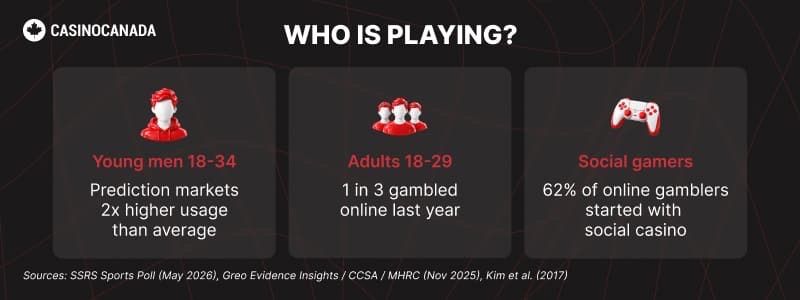
The clearest picture of who's engaging with these products comes from a November 2025 report by Greo Evidence Insights, the Canadian Centre on Substance Use and Addiction and Mental Health Research Canada, based on survey data from more than 8,000 people. It found roughly one in three young adults aged 18 to 29 had gambled online in the past year.
A separate SSRS Sports Poll, published in May 2026, found prediction market usage in North America follows the same pattern: men aged 18 to 34 are the platforms' single biggest user group, trading on them at more than twice the rate of the general population.
Free-to-play social casino games have a research trail of their own worth understanding, less because of the games themselves than because of what they reveal about player behaviour.
A 2018 CAMH study using Ontario's Youth Gambling Survey found nearly one in eight high school students had played social casino games. Separate Canadian research (Kim et al., 2017) found that 62% of online gamblers had started out on social casino games before gambling for real money.
Public appetite for prediction markets is more cautious. A July 2026 subscriber survey by The Logic found almost 58% of respondents don't support legalising prediction markets in Canada, and more than half don't think existing sports-betting platforms are appropriately regulated in the first place.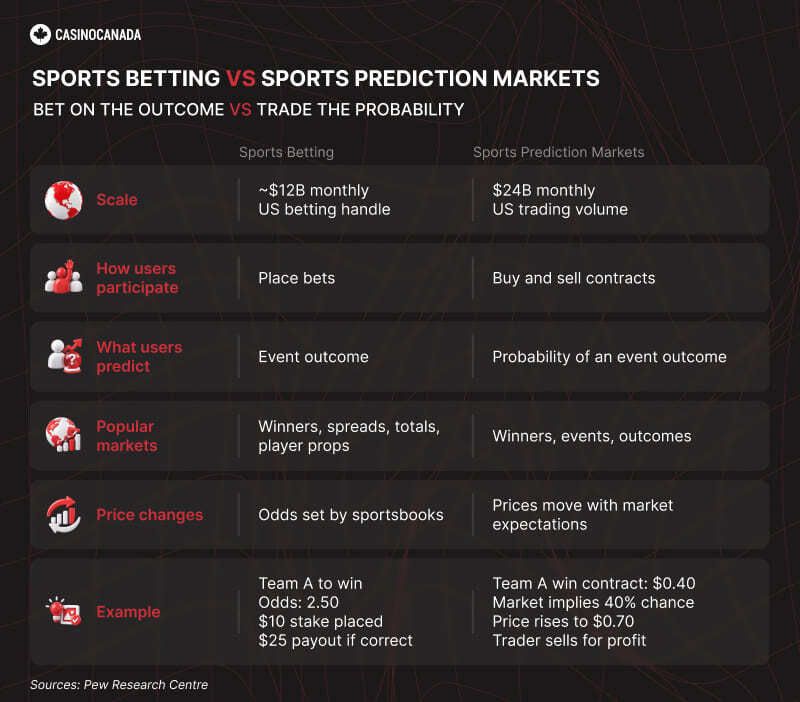
Reaction in Other Markets
Canada isn't the first market to run into this problem. The UK's Gambling Commission closed the "no real money" loophole directly: tradeable in-game items, "skins" that function the same way virtual credits do in a free-to-play social casino app, are treated as a de facto currency the moment they can be traded for value, and betting with them requires a gambling license.
Australia regulates through classification rather than gambling law: rather than litigating whether a loot box or social casino game meets a legal definition of gambling, the Australian Classification Board simply age-gates them, a minimum M rating, meaning recommended for users 15 or over for chance-based loot boxes, and a mandatory R18+, meaning adults over 18 only, for simulated gambling.
Neither is a perfect template, but both show the "is it legally gambling" question isn't the only lever available. Canada's current approach effectively has one: license it or leave it alone.
An Ill-Equipped Framework
Ontario and Alberta's regulatory models answer a specific question: how do you safely license and tax a casino-style operator? The harder question is what to do with activities that live in the space in between: a fantasy sports contest, a free-to-play slots app, a Kalshi contract, or even a video game with gambling involved.
None of it meets the legal definition that triggers provincial oversight, and all of it, by the CCSA and Greo's own data, reaches the same young, digitally fluent audience that regulated operators are trying to reach through more conventional channels.
Fantasy football group chats, free-to-play games, and prediction platforms are mainstream, everyday behaviours that sit on legally undefined ground. The current regulatory system was built for online casino and sports betting, and it has failed to anticipate a generation that behaves much differently online.

FAQ
Is fantasy sports considered gambling in Canada?
Yes, if there is an entry fee involved. As such, it remains technically illegal in large parts of Canada. Ontario, however, treats fantasy sports as sports betting, meaning it falls under the responsibility of the province's regulator.
Are social casino games legal in Canada?
Yes, they are legal and are not considered gambling. This is because players wager virtual credits rather than real money; social casino games don't meet the Criminal Code's three-part test for gambling, which requires prize, chance and consideration. They're legal and entirely unregulated nationwide.
Are prediction markets legal in Canada?
Partially. Canadian regulators classify prediction market contracts as financial derivatives, not wagers, routing them through securities law instead of the Criminal Code. Platforms like Wealthsimple's Kalshi integration can offer economic, financial and climate contracts, but sports and political contracts remain excluded.
How does Canadian law define gambling?
Under Section 206 of the Criminal Code, an activity is gambling if three elements are present: a prize, chance, and consideration. Canadian courts have rejected a "predominance" test used elsewhere, so any element of chance, however minor, is enough to classify an activity as gambling; only genuinely chance-free activities are exempt.