
One country, multiple regulators: Canada's provincial model will be exposed during the World Cup
Five years after legalising single-event betting, Canada's betting market is about to face its biggest test as it co-hosts the World Cup alongside the USA and Mexico.
While the Ontario market continues to prosper, and Alberta is set to open later this year, there is still no federal-level gambling regulator and no national licensing framework.
All of this raises the question: Is Canada's betting infrastructure, which currently consists of a patchwork of provincial regulators, crown corporation monopolies, and a single open market in Ontario, with no national regulator, ready for the World Cup?
Research highlights
-
iGaming Ontario reports approximately CAD 82.7 billion in wagers and CAD 2.9 billion in revenue for 2024–25.
-
BCLC data from the 2022 World Cup shows 99% of bets on PlayNow backed Canada to advance from the group stage.
-
Studies from Blask's 2025 iGaming Landscape Report show Canada's total online gambling market reached approximately CAD 13.15 billion in 2025, with offshore platforms growing at 40.2% year-on-year.
-
Provinces outside Ontario carry significant offshore leakage rates: Saskatchewan at 93%, Alberta and Manitoba at 88%, and British Columbia at approximately 51%.
-
Studies from the IBIA and H2 Gambling Capital estimate approximately CAD 2.77 billion in lost taxable gross gambling revenue across non-Ontario provinces between 2024 and 2028.
-
Global World Cup 2026 betting turnover is projected to exceed the $38 billion/CAD 52.64 billion wagered on Qatar 2022, according to Stats Perform.
A fragmented system
Under sections 91 and 92 of the Constitution Act, individual provinces determine how gambling is organised.
As a result, Canada has a patchwork system of different regulations, with each province setting its own standards.
Ontario is currently the only province to have a fully open market for private operators, having opened its doors in 2022. Alberta is transitioning to its own model, but the other provinces operate monopoly models.
This lack of national standards has proven manageable for the last five years, but the World Cup is likely to highlight the flaws in the model.
One country, multiple markets
Canada will host 13 matches throughout the World Cup across Vancouver and Toronto. Canada will play all three of their group stage games on home soil, with their first match being against Bosnia & Herzegovina on June 12th in Toronto.
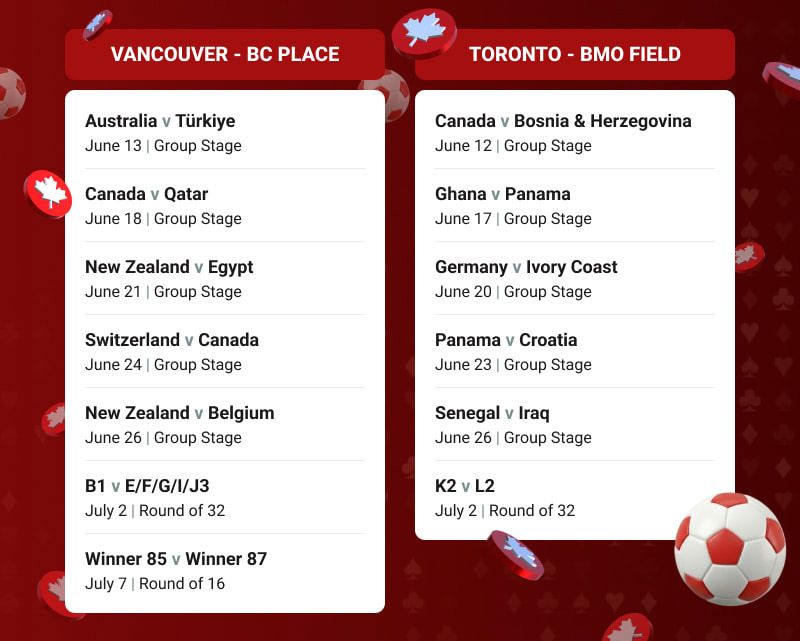
2026 FIFA World Cup fixtures in Canada
Germany will be the biggest name to take to the field in Canada during the group stages when they play the Ivory Coast on June 20th, with the country also hosting a round of 32 and a round of 16 fixture.
There is no single betting market for those matches. A bettor in Ontario will have access to a competitive, open market with nearly 50 licensed operators, competitive odds, and a range of modern betting features. A bettor in British Columbia will use PlayNow, the province's monopoly platform, where betting options and markets are much more limited, while a bettor in Quebec will engage with Loto-Québec's Mise-o-jeu offering, which again is a province-run platform with no competitive alternatives. Same country, same tournament, but the betting options are going to be severely different depending on which province you happen to live in.
Ontario as proof of concept
The success of Ontario's regulated market is often hailed as a roaring success both within Canada and the wider iGaming industry.
iGaming Ontario's market reporting shows that in FY 2023–24, the province generated CAD 63.0 billion in wagers and CAD 2.4 billion in gaming revenue.
By FY 2024–25, iGaming Ontario reports total wagers of CAD 82.7 billion and revenue of CAD 2.9 billion.
iGaming Ontario and industry commentary also highlight channelisation, that is getting customers to come to the market from unregulated markets, as a success metric, with reported rates above 80% as of 2025.
Channelisation is achieved through several methods. Ontario's licensing model attracted established international operators into the market, all of which offered attractive betting markets and features for bettors. The province also promotes responsible gambling and provides a framework that offers bettors support, as well as compliance guidelines that mean operators must meet a certain standard.
The security offered by these licenses, as well as the diverse betting options, are incredibly effective ways of getting bettors to come over from the unregulated market.
Channelisation sits at the heart of Ontario's success story, though the headline figures require context.
The third-year channelisation report commissioned by the AGCO and iGaming Ontario found that 83.7% of Ontarians choose to play on regulated sites. The province has set a target of 90% by the end of its fourth year.
From a technical and operational perspective, there is little to no doubt that Ontario will be able to handle the World Cup. In fact, the province is likely to be one of the most successful markets in the world during the tournament.
But it is also ring-fenced. iGaming Ontario explicitly requires players to be physically located within the province to access regulated platforms. These boundaries will be the biggest challenge Canada faces during the World Cup.
Figures also show that Canadians have a very strong appetite for betting when their country is involved.
Data from BCLC showed that 99% of bets on its PlayNow platform during the 2022 World Cup backed Canada to advance from the group stage, with 82% backing Canada to win Group F outright. It is worth noting that the BCLC did not publish exact handle figures for the tournament, so the total volume of bets placed is not available.
At Sports Interaction, there were three bets on Canada for every one on Belgium, with handle roughly three times higher than in a typical Canada market.
This clearly demonstrates a trend. These figures are likely to be even higher during the 2026 World Cup, with Canada not only a participant but also a co-host.
The Alberta timing problem
A lot of industry focus in 2026 is on the opening of Alberta's regulated market, but the timing of this launch poses several problems.
AGLC's official iGaming registration materials confirm that operators must complete a dual registration process and integrate with a centralised self-exclusion system. The same documentation sets a deadline of 13 July 2026 for completed applications and fees.
That date falls after the World Cup has already begun, with the tournament already into the quarter-finals by then.
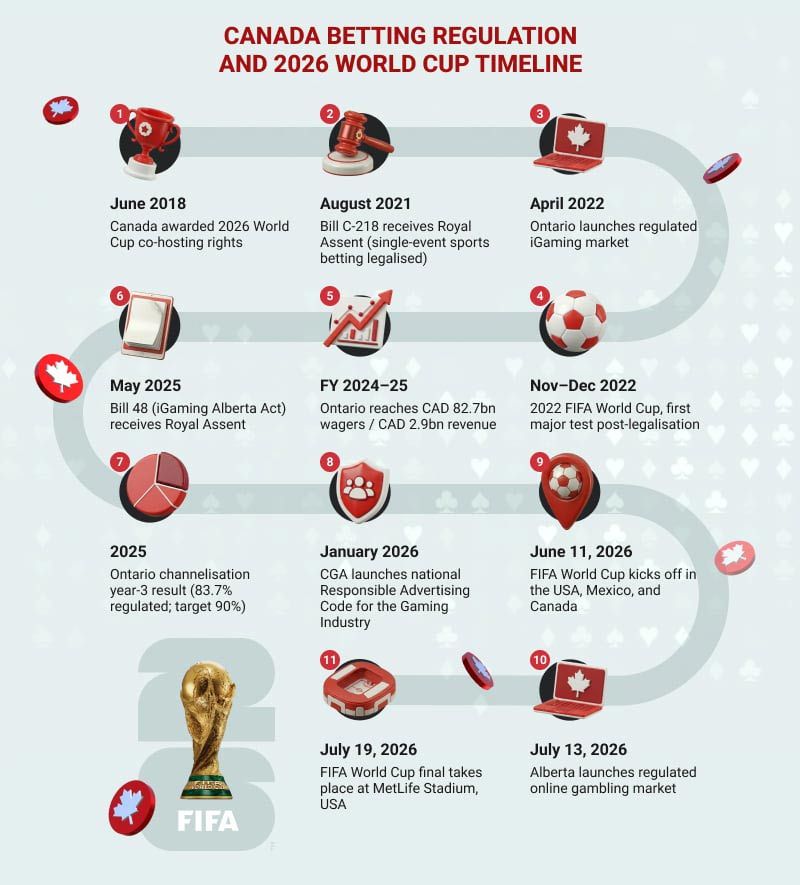
Canada betting regulation and 2026 World Cup timeline
This creates a practical risk. Analysis from Blask's 2025 iGaming Landscape Report found that Alberta currently has an 88% offshore leakage rate - meaning the majority of the province's online betting activity already goes through unregulated channels. If Alberta's competitive market is not fully operational at kickoff, that is only likely to grow, with the province likely to see record-breaking bets placed.
Beyond the timing, another issue the market faces is consumer protection throughout the tournament. Canada introduced its first national gambling advertising code - the Canadian Gaming Association's Code for Responsible Gambling Advertising- in January.
However, this is an industry-led framework with no legal backing. Unfortunately, Bill S-211, which would make it a federal matter, has still not been passed.
The research backs up the concern. A study published in Addictive Behaviours Reports in 2026 from the University of Sheffield, examining betting behaviour during the 2022 World Cup, found that television gambling advertising increased the frequency of football betting by 16% to 24% during matches on channels that carried such ads.
Participants were also between 22% and 33% more likely to place a bet during matches that included gambling advertising.
Tackling unregulated gambling
The biggest task during the tournament will be attempting to control the number of Canadians accessing the black market.
A Justice Canada release cited Canadian Gaming Association estimates of approximately CAD 10 billion in illegal betting via organised crime and CAD 4 billion via offshore sites prior to legalisation in 2021.
Subsequent research conducted by PLOS ONE has questioned the precision of these figures, highlighting methodological limitations in estimating offshore market size.
What is not disputed is accessibility, or the scale of the unregulated market Canada can capture outside of Ontario.
Studies from Blask's USA and Canada iGaming Landscape 2025 Report show the picture starkly: Saskatchewan carries an estimated 93% offshore leakage rate.
Alberta and Manitoba sit at 88%. Even British Columbia, where BCLC has operated a regulated platform for years, holds only around 49% of the online market.
Quebec's Loto-Québec has been operating since 2010, and offshore operators still account for more than 80% of activity in the province.
The stats paint a clear picture: the monopoly model is not working.
According to Blask's report, the black market grew at 40.2% across the year, nearly double the 23.1% recorded by licensed domestic operators.
Studies from the International Betting Integrity Association, prepared by H2 Gambling Capital, estimate that offshore dominance in provinces outside Ontario could account for approximately CAD 2.77 billion in lost taxable gross gambling revenue between 2024 and 2028.
Before Ontario launched its competitive market in April 2022, approximately 70% of online gambling in the province was occurring on unregulated sites.
This creates a mixed picture across the country. Ontario can compete with offshore operators. Other provinces are clearly not equipped, and the World Cup will highlight this.
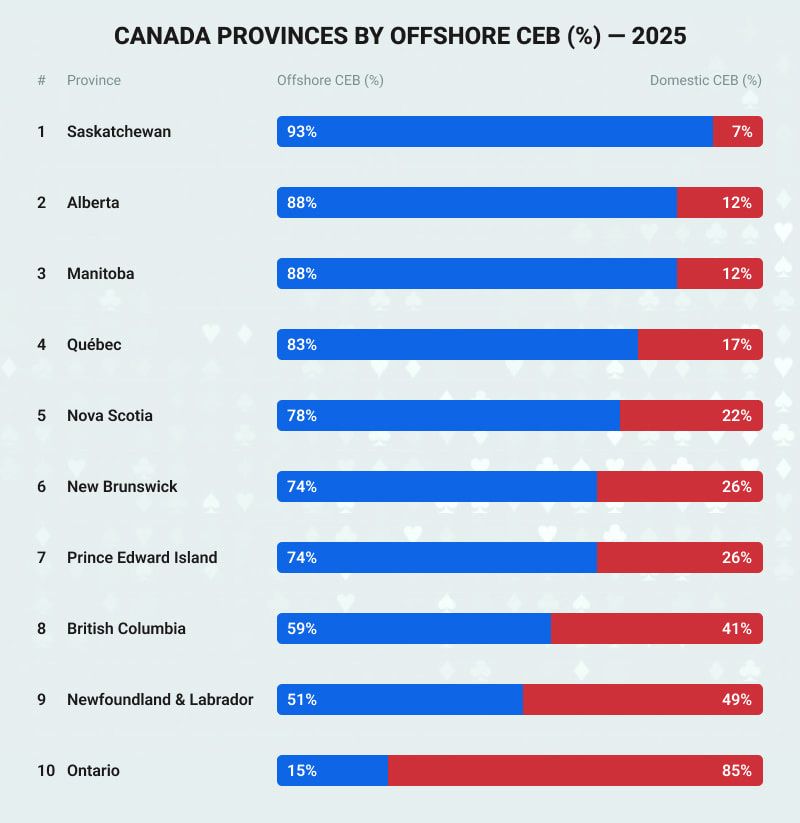
Provincial share of offshore vs domestic CEB in Canada, 2025 (Source: Blask)
Scale without a national framework
Gambling Capital data estimated total wagers for the 2022 World Cup in Qatar were approximately CAD 52.64 billion.
Studies from Stats Perform, which holds the exclusive FIFA World Cup betting data partnership for 2026, already project that this year's tournament will surpass that figure.
In Canada specifically, OpenBet data from 2022 showed a 21% increase in engagement during the tournament, while match-level betting volumes were up to three times higher than typical football events.
Ontario's own reporting shows soccer accounted for 15% of betting wagers in its first year, ranking second among sports, with basketball at the top at 21%.
In 2022, that surge arrived when Canada was merely participating. In 2026, Canada is co-hosting. The emotional engagement will be materially higher. And the regulated infrastructure, outside Ontario, is less equipped for it.
Paysafe's 2026 World Cup research says 46% of Ontarians expect to wager on the tournament, and 9% of them would be first-time bettors. This spike is part of a broader trend, with the same report showing that 19% of respondents surveyed, all of whom are of legal gambling age and based in regulated markets, intend to bet for the first time.
While this is not representative of the global audience, it points to a clear first-time conversion dynamic that could scale fast during a tournament of this size. FIFA expects roughly six billion people to engage with the competition across platforms, so even a small fraction of legal-age viewers in regulated markets placing their first bet would imply operators could acquire millions of first-time bettors.
Infrastructure versus coordination
From a technical perspective, parts of Canada's system are ready. Ontario is seen as one of the best-regulated markets in the industry, and systems such as its self-exclusion scheme highlight a maturing market.
Alberta is building similar infrastructure, although time is not on its side. The issue is the lack of coordination and consistency across the country.
The lack of a national enforcement strategy and the huge increase in betting interest look to be a dangerous combination.
With each province managing the tournament differently, the World Cup will be a live stress test for the country, exposing a significant structural gap in how gambling is regulated. The impact of this, especially on gamblers within Canada, remains to be seen.