


How AI Casino Bots and Machine Learning Are Reshaping Online Gambling
Finding out how online casinos use AI requires getting access to proprietary systems used by operators, which is nearly impossible to do. In this article, we analyze publicly available peer-reviewed studies, industry reports, and operator disclosures to provide a clear picture of where things actually stand in 2026 regarding AI integration.
What the Research Says
A 2025 study in the Journal of Gambling Studies interviewed 41 industry experts. By 2023, personalized player systems, predictive analytics, and AI-supported decision pipelines were no longer considered exploratory, as they were in 2021. The researchers title the paper directly: "The Future of the Gambling Industry is AI."
The study stated that AI moved from pilot to production in these five areas:
- Human-AI collaboration - AI spots patterns in a player’s activity, while humans make decisions on what to do next.
- Regulatory adaptation - operators building compliance tooling in response to tightening oversight.
- Model development - proprietary ML models trained on live behavioural data of players.
- Player engagement - personalization of game feeds, bonus offers, and session UX.
- Ethics and risk frameworks - some companies have started building governance around how they use these models.
That last point is still open, as some experts think that, in many cases, personalization crosses into manipulation.
AI Applications Across the Casino Stack
The table below shows the main AI use cases and their documented deployment evidence.
|
AI Application |
What It Does |
Evidence |
|
Behavioral monitoring |
Flags deposits and session patterns deviating from a player's regular activity |
SOFTSWISS 2026 - described as a default feature of the operator stack |
|
Responsible gambling |
Catches early warning signs before the player self-reports a problem |
Binesh et al. (2026) - standard practice according to 41 experts |
|
Personalization engines |
Tailors game feeds, bonus offers, and session UX to individual activity |
iGamingToday - one operator documented an 8-10% uplift in session revenue |
|
Fraud & AML detection |
Classifies transactions in real time, flagging bonus abuse and suspicious fund movements |
SOFTSWISS 2026 - behavioural biometrics now serve as the primary defense layer |
How we put AI to work at CasinoCanada
On the player-facing side, we run an AI-powered system built specifically for the Canadian market. It handles online casino comparisons, breaks down bonus terms, and checks licensing and eligibility by province.
On the editorial side, we use AI to gather verified user feedback from player reviews. The system cross-references licensing records, payout speed, and responsible gambling practices across 260+ licensed platforms and distills them into structured summaries.
When Regulators Mandate AI
In most cases of AI adoption, companies try it out, see a return on investment, and then scale up. In the Canadian market, the regulator is the one who is driving the process.
In June 2025, Ontario's gaming authority AGCO issued formal guidance, saying that relying solely on self-exclusion to prevent problem gambling is no longer compliant. What that means is that operators now have to be able to monitor player behaviour in real time and flag high-risk activity before it's too late. Since no one can realistically keep an eye on 1.3 million active accounts at the same time, even the smallest operator is starting to get on board with the use of machine learning.
This leads to a new problem for Canadian players, which is how to verify if a casino has integrated AI-powered compliance tools or just claims that it has.
What Operators Are Spending
The clearest industry-level picture comes from the SOFTSWISS AI Trends in iGaming 2025 report. It tells us that 2025 was the year that generative AI pilot projects started to give way to full-scale deployments in personalization, fraud detection, and automating compliance.
According to iGamingToday's analysis of operators, one of the biggest operators saw a jump of 8-10% in session revenue after using AI to work out the best games to show to the player at the right time of day. The same single system runs fraud detection, VIP identification, and responsible gambling interventions.
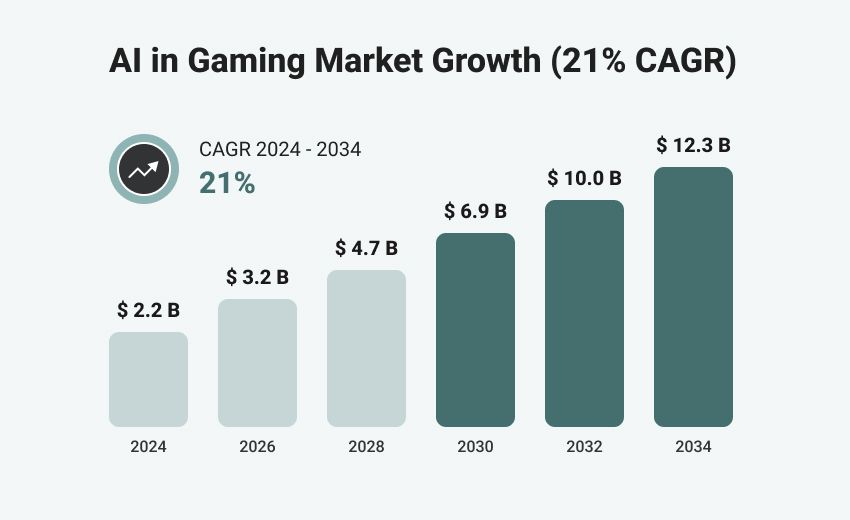
AI use in the gaming market is projected to grow at 21% CAGR (2025–2034) — Research and Markets (2025).
We are looking at gaming as a whole here rather than just iGaming, because the information on an iGaming-only AI market is rarely published in a verifiable public form. Gaming gives us a cleaner view of how fast money is moving into the underlying tech.
How the AI Pipeline Works
Inside all modern online casinos, there is a massive flow of real-time data. Every login, payment, and click feeds directly into a single shared AI system.
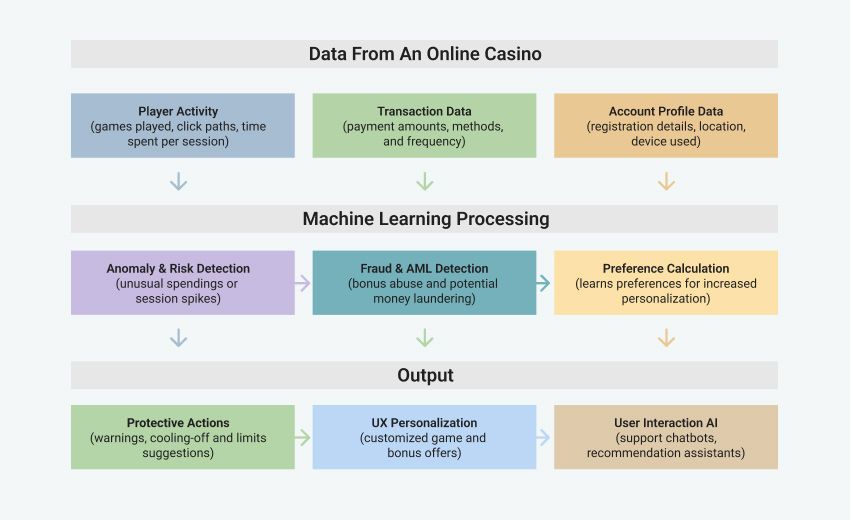
This system is focused on two tasks:
- Engagement: It learns what you like and tries to make sure you keep coming back by personalizing your experience.
- Protection: It keeps an eye out for anyone trying to scam the system and makes sure you aren't developing a gambling problem.
To put this into perspective, platform providers like SOFTSWISS reviewed around 16,000 responsible gambling cases in just the first half of 2025 alone, using these exact systems to step in when players showed risky behaviour.
The problem is that both functions use the same data and models to drive profits and keep players safe. This creates issues for regulators who need to figure out where to draw the line between keeping a player entertained and safe at the same time.
Final Thought
Personalization, fraud detection, and responsible gambling monitoring aren't three separate systems. They run on one shared pipeline of behavioural data serving the operator, the regulator, and the player. Often, the interests of these three parties don’t line up.
For those who are building or studying ML systems, iGaming is a rare live environment: consumer scale, hard compliance stakes, and real consequences for getting the model wrong. That combination is harder to find than it looks.

Related articles
New Casinos

Welcome Bonus
Max. 200% up to C$4,000 + 325 Free Spins
Welcome Bonus
Max. 150% up to C$4,250 + 350 Free Spins

Welcome Bonus
Max. 200% up to C$11,665.50

Welcome Bonus
Max. 100% up to C$3,000 + 50 Free Spins

Welcome Bonus
Max. 200% up to C$30,000 + 50 Free Spins

Welcome Bonus
Max. 100% up to C$1,000 + 100 Free Spins
New